
What is Agility?


Agility - or Agile Movement - is an integrative approach to movement founded by Raphael Berkane, which seeks to connect disciplines rather than isolate them.
It is based on the principle that bodily, artistic and martial systems share common laws, and that putting them into dialogue develops a deeper understanding of movement.
Rather than confining the practitioner to a single style, the method encourages a form of polymathy of movement : learning to move between body languages, to create bridges , to nourish one's main discipline with the contribution of others.
The objective is to train circus performers, dancers, fighters, traceurs, b-boys or movers towards a better capacity for adaptation , transfer and synthesis.
It develops the ability to break the rules , to link practices by creating flow and to bring about a living, personal and coherent movement.
The philosophy of the Agile Movement does not solely pursue functional efficiency; it also recognizes movement as an art . The pursuit of aesthetics, quality, presence, and precision is an integral part of the process.
Being agile, here, means becoming more legible, more connected, more creative in one's way of moving, beyond the boundaries of a discipline.
The 3 pillars of the Agile Movement

Martial Arts
The art of Mastery.
Discipline, structure, intention, timing, purity of movement, surpassing, reading the other, accuracy, martial arts set stages to the mountaintop, in a path where the appreciation of effort, time, and repetition leads to purity of movement and self-realization.
Dance
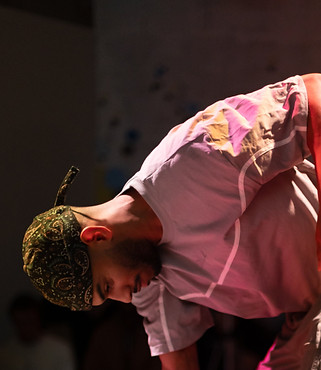
A keen awareness of movement and its expressive dimension. It develops rhythm, musicality, nuance, continuity and the quality of transitions.
Where martial arts cut towards a goal, dance connects towards self-expression. It refines internal perception, subtle coordination, and the relationship to the flow and aesthetics of movement.
This is the cornerstone of the sensitivity and intelligence of movement: expressing a living and embodied action.
.jpg)
Agility
Agility practices (acrobatics, parkour, circus, tricking, diving...) develop a concrete understanding of space, risk and trajectory.
This is the cornerstone of operational capability: knowing how to land on your feet and interact with the real environment, not just with a codified framework.
The 6 Fundamental Energies
The movement can take on different qualities.
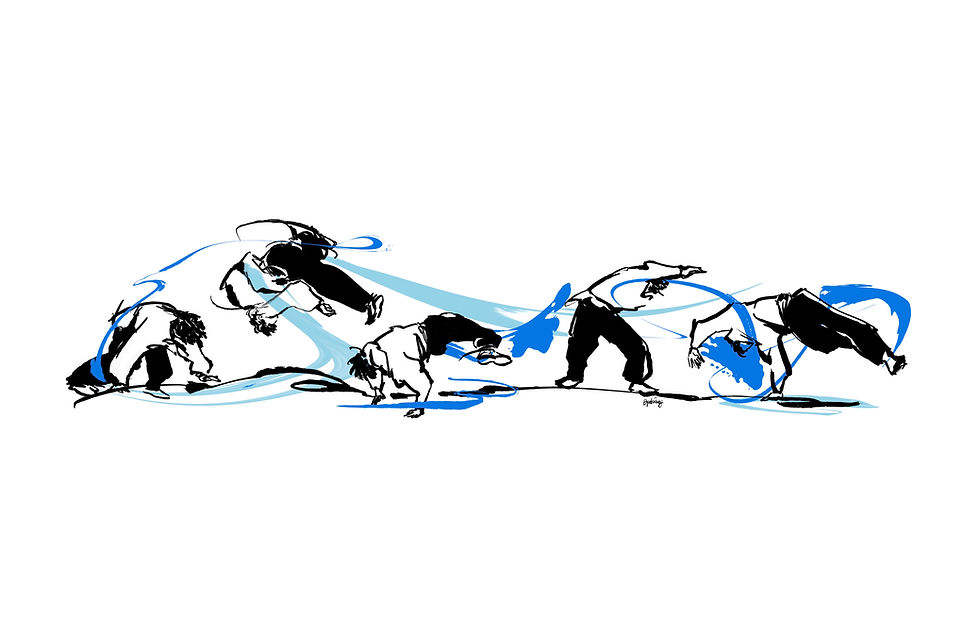
Agility identifies six fundamental dynamics:
Flow
continuity and fluidity
Feu
intensity and commitment
Terre
stability and anchoring
Form
structure and precision
Aura
presence and influence
Origyn
center and intention
Each practitioner possesses natural affinities.
Progression consists of developing all of these qualities, in the quest for the Alif..

An antifragile approach
The Agile movement develops movers capable of adapting to uncertainty and reality, beyond the training room. The goal is also to become friends with constraints and use them as springboards.
For whom?
Agility is for dancers, martial artists, acrobats, performers and movement teachers who wish to expand their understanding of the body.
It is suitable for committed practitioners who seek to develop versatility, adaptability and quality of movement beyond a single style.
The method resonates with movers from many disciplines, united by a passion for movement, an attraction to aesthetics, and a thirst for learning.

Principles
Agility: a vision of movement
The Agility method is based on a logic of integration rather than isolated specialization.
It develops the ability to link, transfer and adapt motor skills between disciplines.
Evolutionary process:
Adaptation : discovering and taming movement
Acquisition : developing fundamental skills
Integration : linking skills
Improvisation : Acting in real time in the face of the unexpected
Mastery : Embodying movement under real pressure
Conclusion
Agility is a school of movement.
She seeks to train capable, controlled and expressive bodies, ready to perform in any environment.
Freedom of movement is not a permanent state. It is a direction .
Experiencing Agility
Understanding Agility requires practice.
The workshops provide an opportunity to explore the method in varied environments, to experiment with adapting to constraints and to develop real agility.


Founder
Hybrid dancer, choreographer and international trainer, Raphaël Berkane is the creator of the Agility method - a transdisciplinary approach to movement that links dance, martial arts, acrobatics and body exploration around common principles.
With over twenty years of experience in movement and dance, he develops cross-training frameworks aimed at creating adaptable and versatile practitioners. His work emphasizes the integration of systems rather than the isolation of styles.
He is the founder and artistic director of the company Flèche and co-founder of Call Out: The Game, a collectible movement card game.
Raphael transmits his method through workshops, intensive courses and immersive formats in Europe.
Based in Switzerland, his background combines performance, pedagogy, martial arts and acrobatic practices.
Few benchmarks and experiences
• Creator of the Agility method | Agile Movement
• Artistic Director - Flèche Company
• Co-founder - Call Out: The Game
• Youth & Sport national Instructor (Switzerland)
• 1st dan black belt - Seishin Ryoku
• Stuntman trained at Campus Univers Cascade
• Professional Acrobat
• Practitioner of Systema, Capoeira, Wing shun
• Winner — World of Dance Switzerland 2024
• Winner — Swiss Dance Tour 2022
• Winner — Stylez Battle (international)
• Happy father
• More than 3,000 practitioners trained through its workshops and programs

© 2035 by Agility Movement Method – Agile Movement. Powered and secured by Wix